

The One Big Beautiful Bill Act (H.R. 1), passed by the House on May 22, 2025, is a major reconciliation bill that builds on the 2017 Tax Cuts and Jobs Act (TCJA). It extends and expands tax cuts, deregulates several federal programs, makes cuts to social spending, and introduces pro-family policies like Child Savings Accounts and a higher Child Tax Credit.
Critics have raised red flags about the bill’s impact—especially on deficits, the poor, and children’s eligibility for vital programs. But do those claims hold up? This blog breaks it all down.
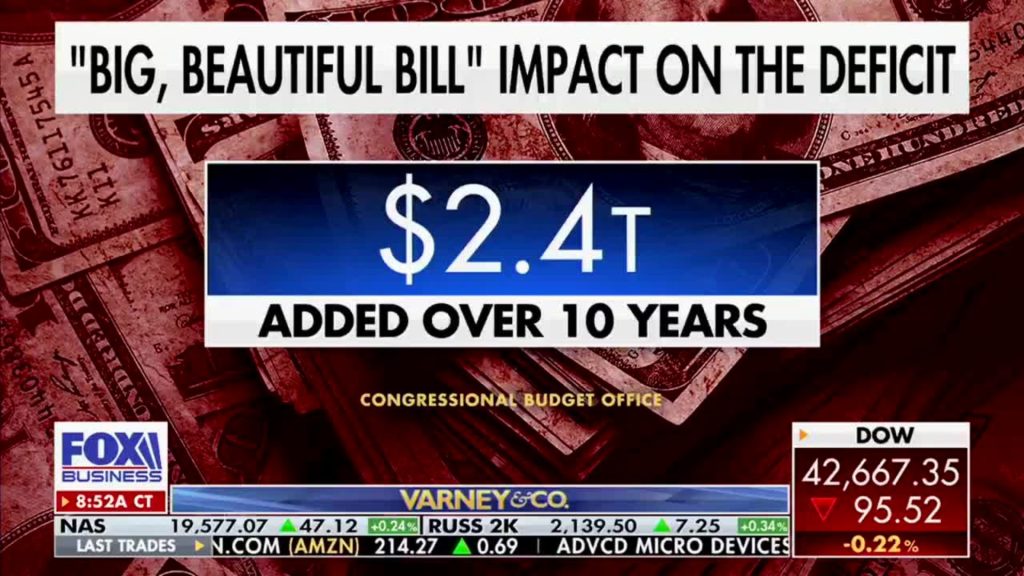
CLAIM 1: “It increases the deficit by $2.4 trillion.”
Rating: Mostly True
Yes, the Congressional Budget Office (CBO) does score the bill as adding $2.4 trillion to the federal deficit between 2025–2034. But that’s only part of the picture. Roughly $3.67 trillion in tax cuts are offset by $1.25 trillion in spending reductions. Add in expected economic growth—projected at 1.5–2% over 10 years—and you could see an additional $500–$800 billion in federal revenue. Tariff adjustments in the bill are estimated to bring in another $2.8 trillion, potentially more than covering the deficit impact.
So yes, on paper the deficit increases—but real-world factors could narrow that gap significantly.
CLAIM 2: “It gives tax breaks to the wealthy while cutting aid to the poor.”
Rating: Partially True
The bill extends tax cuts that benefit all income levels, but yes—higher earners benefit more in raw dollar terms. According to the CBO, the top 10% will see a 4% increase in household resources by 2027. The bottom 10%? A 2% decrease, mainly due to cuts in Medicaid and SNAP.
However, the bill also includes $80–$100 billion annually in pro-family benefits:
Child Tax Credit: $2,500 per child for families under the income threshold.
Child Savings Accounts: A one-time $1,000 deposit for newborns plus optional parent contributions up to $5,000 per year.
These offset many of the losses for low- and middle-income families.
CLAIM 3: “It cuts Medicaid, SNAP, Pell Grants, and Medicare.”
Rating: Mostly True
Medicaid: The CBO says 7.8 million people could lose coverage. About half of those may be children—but not due to loss of eligibility. The problem is work requirements for adults (80 hours/month) and bureaucratic hurdles. In Texas, 65% of Medicaid disenrollments during the COVID unwinding were children—even though they still qualified.
SNAP: $267–$300 billion in cuts, with 3 million households affected. Benefit levels fall from $6.20/day to $5.50/day. Four million children could be impacted—but again, eligibility remains. The cuts come from stricter adult work rules (20 hours/week) and less generous benefit formulas.
Pell Grants: About 1.4 million students could lose access due to new requirements (e.g., taking at least 30 credit hours annually). This disproportionately affects part-time students.
Medicare: Sequestration is triggered, cutting up to $500 billion—but could end up closer to $300 billion with economic growth.
These cuts are real. But so are the family-focused offsets, which aim to rebalance the scale.

CLAIM 4: “The top 1% gets a $664 billion tax break.”
Rating: Mostly True
Yes, the top 1%—who already pay 40% of all federal income taxes—stand to gain the most from tax cuts. They may receive a combined $664 billion in relief, per the Tax Foundation. But it’s not just a giveaway: higher-income earners often invest in job-creating businesses. After the TCJA in 2017, the economy added 2.1 million jobs in 2018 alone.
Also worth noting: middle-class families with children will see significant gains via the Child Tax Credit and Trump Accounts.
CLAIM 5: “It raises taxes on low-income Americans.”
Rating: Absolutely False
There are no new taxes on low-income families. In fact, the bill makes tips, bonuses, and overtime tax-free under certain thresholds, making it more attractive to work more. While some families may lose value from benefit cuts, no one in the bottom bracket is seeing a tax hike.
CLAIM 6: “It’s unfair to small businesses.”
Rating: Mostly False
The bill keeps and expands many pro-small-business provisions:
23% passthrough deduction (Section 199A)
100% bonus depreciation
Expensing cap raised to $2.5 million
Some service businesses (e.g., consultants, lawyers) face limits—but overall, the NFIB and other small business groups back the bill, citing increased hiring and wage growth post-TCJA.
CLAIM 7: “It adds $20 trillion to the national debt.”
Rating: Absolutely False
That number is a wild exaggeration. The CBO says $2.4 trillion over 10 years. Even factoring in growth and tariffs, you might see $1.6–$1.9 trillion. The $20 trillion claim ignores offsets and inflation, and assumes zero economic benefits—which is unrealistic.
What About the Children?
The most aggressive criticisms say this bill “kicks kids off Medicaid and SNAP.” That’s not true. Income thresholds stay the same (138% of poverty for Medicaid, 130% for SNAP), and CHIP is untouched. Any loss of benefits is indirect—because parents didn’t meet work hours, or due to paperwork mistakes. This matters, but it’s not the same as being “cut off.”
Family-Friendly Provisions
Child Savings Accounts: $1,000 per child born 2025–2029, plus parent contributions. Accounts grow tax-deferred in U.S. index funds. Withdrawals taxed as capital gains.
Child Tax Credit: $2,500 per child from 2025–2028, reverting to $2,000 afterward. Requires valid Social Security numbers.
Additional credits: Adoption credit ($5,000), expanded EITC, and more.
Combined, these add $80–$100 billion/year in support, reaching 70 million kids.
Conclusion
This bill has real trade-offs. Yes, it cuts spending and adds to the deficit—on paper. But it also encourages growth, supports families, and doesn’t actually target the poor or children as critics claim.
Bottom line: The scary headlines aren’t false, but they’re misleading. The truth? This bill could deliver more economic freedom, stronger families, and a more sustainable future—if implemented alongside smart policy and accountability.
Want to know how this impacts your taxes or your business?
Let’s talk. Quartermaster helps small businesses and individuals keep more of what they earn—using every legal strategy available, including the credits and provisions in this bill.
👉 Book a free consultation at quartermastertax.com/consultation.