

The One Big Beautiful Bill Act (OBBBA) introduced a brand-new savings vehicle: Trump Accounts. Think of them as traditional IRAs with a twist—especially designed for children under age 18. While some remain skeptical, the mechanics reveal a potentially powerful tool for long-term wealth building.

Free Money for Newborns
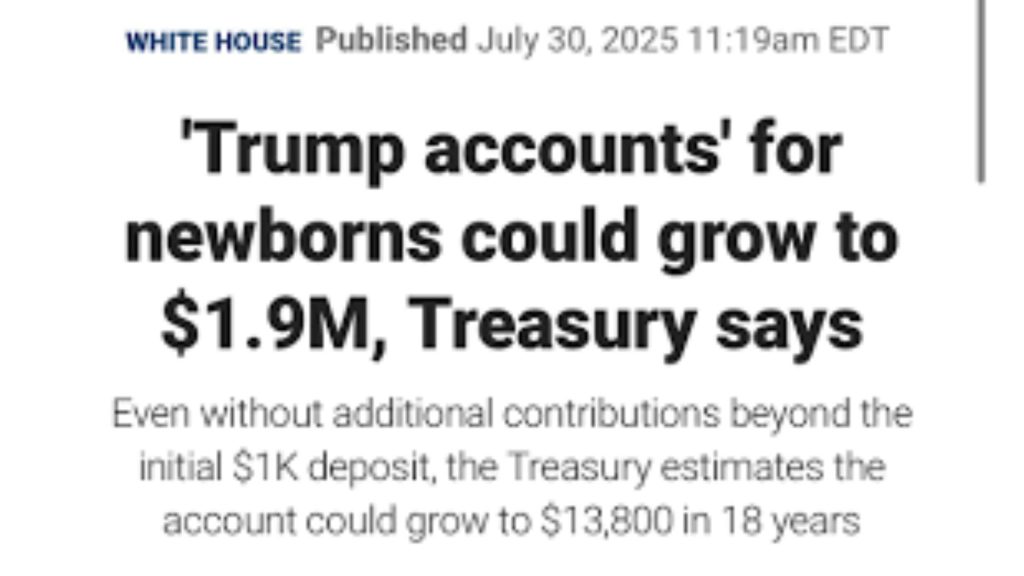
A pilot program is offering $1,000 of seed money for newborns born between 2025 and 2028. Here’s how it works:
Parents can make an election with the IRS on behalf of their newborn (child must have a Social Security number).
Once elected, the government deposits $1,000 into a Trump Account for the child.
Beginning July 4, 2026, parents, grandparents, or others can contribute up to $5,000 annually (adjusted for inflation starting in 2028).
That first $1,000 doesn’t even count against the yearly limit.
Contributions and Growth Before Age 18
Contributions made before age 18 are non-deductible, but funds grow tax-deferred.
No withdrawals are allowed until the child reaches age 18.
Accounts are limited to low-cost, diversified investments like mutual funds or ETFs that track major U.S. indexes.
By design, these rules encourage steady compounding without early cash-outs.
What Happens at Age 18
Once the child turns 18, the Trump Account converts into a traditional IRA. From then on:
The young adult must have earned income to continue making contributions.
Distributions follow standard IRA rules, including the 10% early withdrawal penalty for withdrawals before 59½ (unless an exception applies).
The account’s “basis” will reflect non-deductible contributions—but not the initial $1,000 seed money or any employer/community contributions.
At this stage, the account can even be converted into a Roth IRA if desired.
Employer and Community Contributions
Employers can contribute up to $2,500 annually to Trump Accounts for under-18 employees or their dependents. Contributions are tax-free for employees and deductible for employers.
State, local, or tribal governments and nonprofits can also make tax-free “general contributions” that don’t count toward the $5,000 annual limit.

The Math: Why Trump Accounts Can Win
Let’s run the numbers.
Assume parents contribute $5,000 per year for 17 years (plus the $1,000 starter).
At a 5% annual return, the account would hold about $138,000 by age 18.
If untouched and left to grow until age 60, that balance could reach around $1.2 million.
That’s before factoring in any additional IRA contributions after age 18.
How Trump Accounts Compare
529 Plans / Coverdell ESAs: Great for education, but funds must be used for qualified expenses.
Custodial Accounts: No tax deferral and potential “kiddie tax” exposure.
Trusts: Complex and subject to higher tax rates.
Trump Accounts may not be perfect, but they offer tax-deferred growth, a unique government match at birth, and flexibility down the road.
Key Takeaway
Trump Accounts are unconventional but potentially game-changing. With free starter funds, consistent annual contributions, employer and community add-ons, and decades of compounding, they could become a serious long-term wealth tool for the next generation.